




2.15.10 Worth My Salt
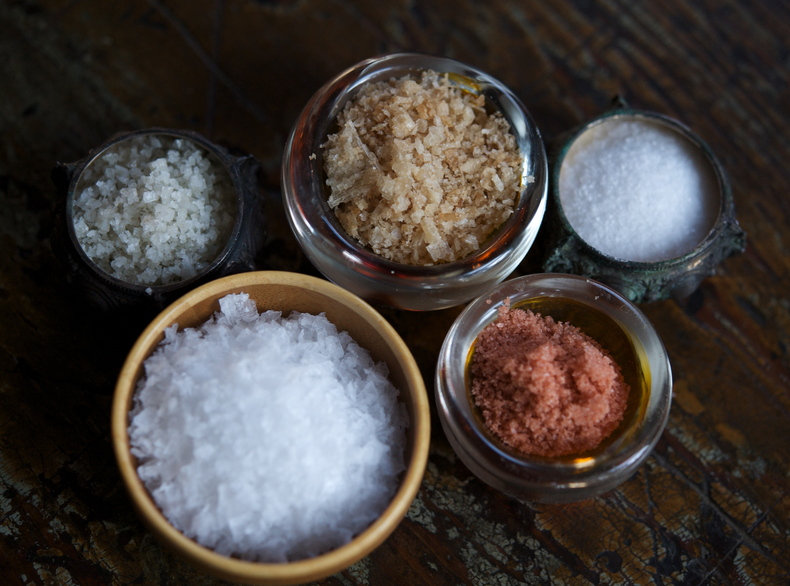
clockwise from bottom left: Maldon, fleur de sel, Halen Môn, kosher and Pristine Sun Fire
I love this expression and its somewhat arcane origins. Salt once had such value that wages were paid in it. I, for one, could not live without the stuff. Having taken you through alternatives to sugar yesterday, I suppose the correct symmetry would have me talking about salt substitutes here, such as they are—soy sauce or even Mrs. Dash, I suppose. But instead I'm going to wax lyrical about my favorite salts. Oh, come off it, you're saying, right? Once it hits your tongue, one salt's the same as the next. Not so. Both texture and taste can vary quite a bit from one salt to another. There's always kosher on hand in my kitchen but it's relegated to the back of the cupboard. I cook with fine sea salt and use all types of flavored and finishing salts to accent dishes. Call me a salt snob, if you will. I'll take it as a compliment.
Sodium is one of the primary electrolytes in the body. Too much or too little salt in the diet can lead to muscle cramps, dizziness or electrolyte imbalance, which can lead to neurological problems or even be fatal. Too much salt over a long period has been associated with increased risk of stroke and heart disease, however that is now being challenged given that adults' kidneys are able to remove excess salt. (But this explains why people with kidney problems have to lay off.)
KOSHER SALT Kosher salt has a much larger grain than most table salt. Its name derives not from its being made in accordance with the guidelines for kosher foods as written in the Torah, but because of its use in making meats kosher. Because of its larger grains, kosher salt does not dissolve readily when used to coat meat, but remains on the surface longer and more effectively draws fluids out. It is not generally recommended to use kosher salt for baking in recipes that call for small amounts of liquid. Without enough liquid, the kosher salt will not dissolve sufficiently, and this can result in small bits of salt in the resulting product. In recipes where there is enough liquid to dissolve all the salt, you must adjust the volume if substituting kosher salt. Most boxes have a conversion guideline. If yours doesn’t, the recommendation is to use twice as much kosher salt (by volume) to replace table salt.
MALDON SEA SALT From the Iron age through to Saxon times, the estuaries and surrounding marshes of Essex, England, were at the centre of the salt-making industry. Maldon sea salt has been made at that historic site since 1882. A completely natural product without artificial additives, it retains valuable seawater trace elements, including magnesium and calcium. It has a pronounced and distinctive "salty" taste that is still mild, with no bitter aftertaste. My favorite thing about Maldon is the large, flaky crystals that shatter easily. I sprinkle it on salads, on whole cheeses drizzled with olive oil, and on my caramels.
GREY FLEUR DE SEL This natural sea salt is from Brittany, France (the name means flower of salt). It’s hand-harvested in the salt fields of Guerande by artisan paludiers (salt harvesters) between May and September only. For every 80 pounds of grey sea salt produced, there is only one pound of Fleur de Sel that is harvested. Rich in trace elements, the taste of Fleur de Sel is reminiscent of the sea. The crystals can be quite hard and, if large, may need to be ground down with a mortar and pestle. This salt is a wonderful compliment to fresh raw vegetables and salads and can elevate the flavor of grilled meats and fish.
HALEN MÔN SMOKED SEA SALT Pure seawater from Wales’ Menai Straits passes through nature’s finest filters–a mussel bed and a sandbank–before its final charcoal filtering. The harvested salt is then smoked over wood chips from an expired 800-year old oak tree. The result is a very special flavor, earthy and warm, with a pronounced saltiness. Its crystal is large and flaky, similar to Maldon. Try this smoky beauty on eggs, oysters and butterscotch pudding.
PRISTINE SUN FIRE SALT A combination of Himalayan Pink Salt, Bolivian Rose Salt, Hawaiian Alaea Clay Salt and Chinese Sea Salt from the original Ming Dynasty Saltworks, this product is extremely rich in beneficial minerals. Besides its beautiful red color, it has a lovely, powdery yet crunchy texture that dissolves more quickly.
KOSHER SALT Kosher salt has a much larger grain than most table salt. Its name derives not from its being made in accordance with the guidelines for kosher foods as written in the Torah, but because of its use in making meats kosher. Because of its larger grains, kosher salt does not dissolve readily when used to coat meat, but remains on the surface longer and more effectively draws fluids out. It is not generally recommended to use kosher salt for baking in recipes that call for small amounts of liquid. Without enough liquid, the kosher salt will not dissolve sufficiently, and this can result in small bits of salt in the resulting product. In recipes where there is enough liquid to dissolve all the salt, you must adjust the volume if substituting kosher salt. Most boxes have a conversion guideline. If yours doesn’t, the recommendation is to use twice as much kosher salt (by volume) to replace table salt.
MALDON SEA SALT From the Iron age through to Saxon times, the estuaries and surrounding marshes of Essex, England, were at the centre of the salt-making industry. Maldon sea salt has been made at that historic site since 1882. A completely natural product without artificial additives, it retains valuable seawater trace elements, including magnesium and calcium. It has a pronounced and distinctive "salty" taste that is still mild, with no bitter aftertaste. My favorite thing about Maldon is the large, flaky crystals that shatter easily. I sprinkle it on salads, on whole cheeses drizzled with olive oil, and on my caramels.
GREY FLEUR DE SEL This natural sea salt is from Brittany, France (the name means flower of salt). It’s hand-harvested in the salt fields of Guerande by artisan paludiers (salt harvesters) between May and September only. For every 80 pounds of grey sea salt produced, there is only one pound of Fleur de Sel that is harvested. Rich in trace elements, the taste of Fleur de Sel is reminiscent of the sea. The crystals can be quite hard and, if large, may need to be ground down with a mortar and pestle. This salt is a wonderful compliment to fresh raw vegetables and salads and can elevate the flavor of grilled meats and fish.
HALEN MÔN SMOKED SEA SALT Pure seawater from Wales’ Menai Straits passes through nature’s finest filters–a mussel bed and a sandbank–before its final charcoal filtering. The harvested salt is then smoked over wood chips from an expired 800-year old oak tree. The result is a very special flavor, earthy and warm, with a pronounced saltiness. Its crystal is large and flaky, similar to Maldon. Try this smoky beauty on eggs, oysters and butterscotch pudding.
PRISTINE SUN FIRE SALT A combination of Himalayan Pink Salt, Bolivian Rose Salt, Hawaiian Alaea Clay Salt and Chinese Sea Salt from the original Ming Dynasty Saltworks, this product is extremely rich in beneficial minerals. Besides its beautiful red color, it has a lovely, powdery yet crunchy texture that dissolves more quickly.
3 Comments