<?xml version="1.0" encoding="UTF-8"?>
<rss version="2.0"
	xmlns:content="http://purl.org/rss/1.0/modules/content/"
	xmlns:wfw="http://wellformedweb.org/CommentAPI/"
	xmlns:dc="http://purl.org/dc/elements/1.1/"
	xmlns:atom="http://www.w3.org/2005/Atom"
	xmlns:sy="http://purl.org/rss/1.0/modules/syndication/"
	xmlns:slash="http://purl.org/rss/1.0/modules/slash/"
	>

<channel>
	<title>Glutton for Life &#187; canning</title>
	<atom:link href="http://gluttonforlife.com/tag/canning/feed/" rel="self" type="application/rss+xml" />
	<link>http://gluttonforlife.com</link>
	<description>A Blog by Laura Silverman</description>
	<lastBuildDate>Mon, 21 May 2012 15:05:10 +0000</lastBuildDate>
	<language>en</language>
	<sy:updatePeriod>hourly</sy:updatePeriod>
	<sy:updateFrequency>1</sy:updateFrequency>
	<generator>http://wordpress.org/?v=3.3.2</generator>
		<item>
		<title>Lady Marmalade</title>
		<link>http://gluttonforlife.com/2011/03/23/lady-marmalade/</link>
		<comments>http://gluttonforlife.com/2011/03/23/lady-marmalade/#comments</comments>
		<pubDate>Wed, 23 Mar 2011 11:44:17 +0000</pubDate>
		<dc:creator>laura</dc:creator>
				<category><![CDATA[Eating]]></category>
		<category><![CDATA[canning]]></category>
		<category><![CDATA[citrus]]></category>
		<category><![CDATA[demerara sugar]]></category>
		<category><![CDATA[grapefruit]]></category>
		<category><![CDATA[jam]]></category>
		<category><![CDATA[mandarin]]></category>
		<category><![CDATA[marmalade]]></category>
		<category><![CDATA[orange]]></category>
		<category><![CDATA[preserves]]></category>
		<category><![CDATA[River Cottage]]></category>
		<category><![CDATA[Seville orange]]></category>
		<category><![CDATA[Sugar in the Raw]]></category>

		<guid isPermaLink="false">http://gluttonforlife.com/?p=5956</guid>
		<description><![CDATA[photos by gluttonforlife OK, I&#8217;m going to say it: I&#8217;m OVER winter. Jeez. More snow? Is this really what we need? And still no working sink or shower in our bathroom. So where&#8217;s the motherfucking silver lining? (Wow. In real life I have a mouth like a truck driver, but on the blog I rarely [...]]]></description>
			<content:encoded><![CDATA[<h6><a rel="attachment wp-att-5957" href="http://gluttonforlife.com/2011/03/23/lady-marmalade/marmalade/"><img class="aligncenter size-large wp-image-5957" title="marmalade" src="http://gluttonforlife.com/wp-content/uploads/2011/03/marmalade-530x397.jpg" alt="" width="530" height="397" /></a>photos by gluttonforlife</h6>
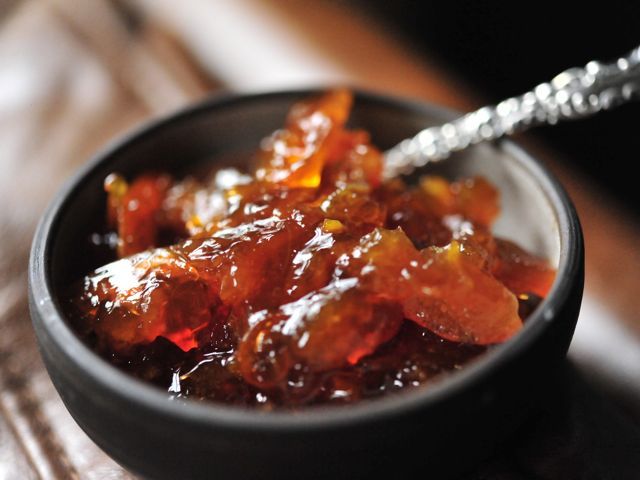
<p>OK, I&#8217;m going to say it: I&#8217;m OVER winter. Jeez. More snow? Is this really what we need? And still no working sink or shower in our bathroom. So where&#8217;s the motherfucking silver lining? (Wow. In real life I have a mouth like a truck driver, but on the blog I rarely stoop so low.) But wait. Yesterday I made marmalade, and today there are five gorgeous jars of the stuff glowing on the kitchen counter. Canning doesn&#8217;t have to be such a big deal, you know. It&#8217;s not imperative that you slave over a hot stove for hours and hours, putting up jar after jar of whatever it is. You can simply look in your fridge and see that you have an enormous bowl of malingering <a href="http://gluttonforlife.com/2011/02/22/kishu-i-dont-even-know-you/" target="_blank">kishu mandarins</a> left over from the 10 pounds you ordered on a lark in January—plus the odd Meyer lemon and pink grapefruit—and decide that you&#8217;re going to make a discreet quantity of marmalade, just for yourself and the occasional very lucky friend.<span id="more-5956"></span></p>
<p><br class="spacer_" /></p>
<h6><a rel="attachment wp-att-5958" href="http://gluttonforlife.com/2011/03/23/lady-marmalade/citrus-3/"><img class="aligncenter size-large wp-image-5958" title="citrus" src="http://gluttonforlife.com/wp-content/uploads/2011/03/citrus-530x397.jpg" alt="" width="530" height="397" /></a>for marmalade, the handcut version really is best</h6>
<p>Mid-winter is not really prime canning time. There&#8217;s no fresh corn at the farm stand, no surplus of cucumbers from your garden; but there tends to be a glut of citrus. Seville oranges, if you can get it together to find some in the 3 weeks or so that they&#8217;re in season, are evidently the <em>ne plus ultra</em> for marmalade. But otherwise, tangerines and mandarins and grapefruit and oranges and lemons will all do just fine. If you don&#8217;t like marmalade, you can <a href="http://gluttonforlife.com/2010/05/14/well-preserved/" target="_blank">preserve some lemons</a>, plain or in a spicy mix of clove and bay leaves; you can make divine grapefruit syrup to stir into cocktails and soda water, or drizzle on pancakes; or you can leave your comfort zone and try your hand at this very particular sticky, addictively bitter English marmalade.</p>
<p><br class="spacer_" /></p>
<p>Of late, when it comes to preserves of the non-meat variety, I have been turning to <a href="http://www.amazon.com/River-Cottage-Preserves-Handbook/dp/158008172X" target="_blank">The River Cottage Preserves Handbook</a> by Pam Corbin. It&#8217;s a gorgeous little book, clearly written with lots of handy tips. I&#8217;ve made the <a href="http://gluttonforlife.com/2010/10/21/leather-fetish/" target="_blank">fruit leather</a> with great success, and can&#8217;t wait to try the homemade bouillon.</p>
<p><br class="spacer_" /></p>
<p>This marmalade recipe calls for the elusive Seville orange, but also says that you can substitute a mixture of sweet oranges, lemons and grapefruits. I used what I had on hand: mostly kishu mandarins, with a couple of Meyer lemons and one big pink grapefruit thrown in. A large, heavy pot really makes all the difference when you&#8217;re cooking up jam, as it conducts heat better and prevents burning. My enormous copper stockpot is a dream. With that and my gigantic wooden spoon I feel positively domesticated.</p>
<p><br class="spacer_" /></p>
<p>According to Pam, you can make marmalade by simply boiling the fruit whole, but she recommends you endure the tedium of first juicing the fruit and then slicing all the peel, which I did, and which I actually found quite delightfully fragrant and pleasantly meditative. Try it. It&#8217;s only 2 1/4 pounds for god&#8217;s sake. Then you soak it all in lots of water; I left mine out on the counter overnight. The next day you boil it for a coupe of hours, stir in lots of sugar and some lemon juice, and cook it down some more. I have to say, mine bubbled away for <em>quite</em> a bit longer than the 25 minutes stated in this recipe. (Almost 2 hours!) I love it when it gets all dark and sticky, but still molten and malleable enough to ladle easily into jars.</p>
<p><br class="spacer_" /></p>
<p>As far as the jars, if you have a dishwasher, you can sterilize them by running them through a hot cycle. Otherwise, my preferred method is to wash them in hot soapy water and dry them in a low oven on a clean dish towel spread on a cookie sheet. Keep them in the oven until the jam is about done, then carefully remove them and place on the counter on a clean dish towel. Sterilize new sealing lids in boiling water. Have all this at the ready, and then ladle the hot, finished jam into the jars, pop on the lids, screw them  &#8221;fingertip tight&#8221; and leave the jars to sit on top of a clean cloth for several hours or overnight without moving. After a while, you will hear the satisfying pop of the seal forming. A noise that may just distract you from the pain of winter and from the hot shower you cannot take.</p>
<p><br class="spacer_" /></p>
<p><strong>WINTER CITRUS MARMALADE</strong></p>
<p><em>adapted slightly from Pam Corbin&#8217;s </em>River Cottage Preserves Handbook</p>
<p>makes about 5-6 pints</p>
<p><br class="spacer_" /></p>
<p>2 1/4 pounds mixed winter citrus, or Seville oranges</p>
<p>1/3 cup lemon juice</p>
<p>10 cups Demerara sugar (or Sugar in the Raw)</p>
<p><br class="spacer_" /></p>
<p>Scrub the oranges, remove the buttons at the top of the fruit, then cut in half. Squeeze out the juice and keep to one side. Using a sharp knife, slice the peel, pith and all, into thin, medium or chunky shreds, according to your preference. Put the sliced peel into a bowl with the orange juice and cover with 10 cups of water. Leave to soak overnight, or for up to 24 hours.</p>
<p><br class="spacer_" /></p>
<p>Transfer the whole mixture to a preserving pan (or a big, heavy pot), bring to the boil, then simmer slowly, covered, until the peel is tender. This should take about 2 hours, by which time the contents should have reduced by about one third. (Mine really didn&#8217;t seem to be that reduced, but it wasn&#8217;t a problem, although later I did end up cooking it almost an additional 2 hours.)</p>
<p><br class="spacer_" /></p>
<p>Stir in the lemon juice and the sugar. Bring the marmalade to  boil, stirring until the sugar has dissolved. Boil rapidly until the setting point is reached*, about 20-25 minutes (or, of you&#8217;re me, until it&#8217;s q rich dark color and getting rather sticky). Remove from the heat. Leave to cool for 8-10 minutes—a little longer if the peel is in chunky pieces—then stir gently to disperse any scum. Pour into warm, sterilised jars and seal immediately. Use within 2 years.</p>
<p><br class="spacer_" /></p>
<p>*To determine the setting point: it&#8217;s either 220º, if you have a thermometer, or the point at which it passes the crinkle test. The Crinkle Test: Drop a little jam onto a cold saucer (put it in the fridge when you start making the jam). Allow to cool for a minute, then push gently with your fingertip. If the jam crinkles, you&#8217;ve reached the setting point.</p>
]]></content:encoded>
			<wfw:commentRss>http://gluttonforlife.com/2011/03/23/lady-marmalade/feed/</wfw:commentRss>
		<slash:comments>2</slash:comments>
		</item>
		<item>
		<title>Jammin&#8217;</title>
		<link>http://gluttonforlife.com/2010/07/30/jammin/</link>
		<comments>http://gluttonforlife.com/2010/07/30/jammin/#comments</comments>
		<pubDate>Fri, 30 Jul 2010 11:26:33 +0000</pubDate>
		<dc:creator>laura</dc:creator>
				<category><![CDATA[Eating]]></category>
		<category><![CDATA[apricot]]></category>
		<category><![CDATA[apricot jam]]></category>
		<category><![CDATA[canning]]></category>
		<category><![CDATA[condiment]]></category>
		<category><![CDATA[fruit]]></category>
		<category><![CDATA[jam]]></category>
		<category><![CDATA[preserves]]></category>
		<category><![CDATA[vegetarian]]></category>

		<guid isPermaLink="false">http://gluttonforlife.com/?p=3620</guid>
		<description><![CDATA[photos by gluttonforlife Having already waxed poetic about peaches, I feel I must give these luscious apricots their due. Seldom have I seen such perfect specimens, firm yet yielding, their golden hue tinged with a pink blush. I find that so often apricots can be mealy and tasteless, but these are a revelation: sweet-tart, juicy, with [...]]]></description>
			<content:encoded><![CDATA[<h6><a rel="attachment wp-att-3621" href="http://gluttonforlife.com/2010/07/30/jammin/apricots1/"><img class="aligncenter size-large wp-image-3621" title="apricots1" src="http://gluttonforlife.com/wp-content/uploads/2010/07/apricots1-530x397.jpg" alt="" width="530" height="397" /></a>photos by gluttonforlife</h6>
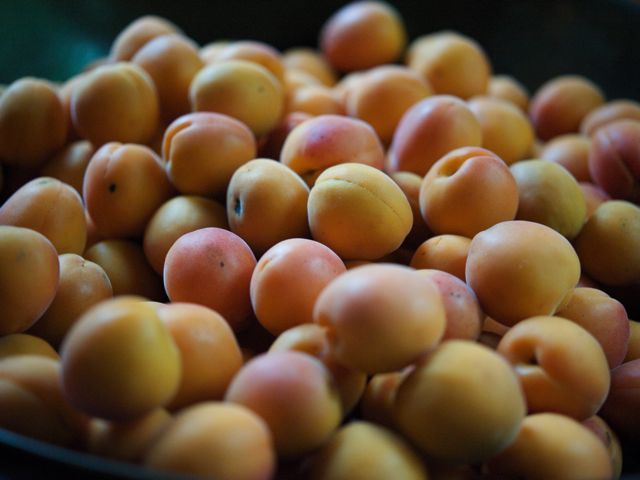
<p>Having already waxed poetic about peaches, I feel I must give these luscious apricots their due. Seldom have I seen such perfect specimens, firm yet yielding, their golden hue tinged with a pink blush. I find that so often apricots can be mealy and tasteless, but these are a revelation: sweet-tart, juicy, with a delicate perfume all their own. I came away from the farmstand with 7 quarts and every intention of replicating the vanilla-scented jam my mother-in-law so enjoyed 2 years ago. If you&#8217;ve never made jam, let me just warn you that most recipes call for what seems like an obscene amount of sugar, but there is another way. This time I decided to make a batch using some <a href="http://www.pomonapectin.com/" target="_blank">powdered pectin</a> and relatively small amounts of sugar and honey. Sadly, I wasn&#8217;t totally thrilled with the results. I found the jam to be less crystalline; it seemed to have a slightly cloudy and over-gelled quality. I probably need to experiment a bit more, with quantities and timing, but I just haven&#8217;t had the extra time lately. So for now, I&#8217;m going to put these up the old-fashioned, and use organic sugar. It&#8217;s not like jam is something that gets eaten by the cupful anyway&#8230;<span id="more-3620"></span></p>
<p><br class="spacer_" /></p>
<p><a rel="attachment wp-att-3622" href="http://gluttonforlife.com/2010/07/30/jammin/apricots2/"><img class="aligncenter size-large wp-image-3622" title="apricots2" src="http://gluttonforlife.com/wp-content/uploads/2010/07/apricots2-530x397.jpg" alt="" width="530" height="397" /></a></p>
<p><br class="spacer_" /></p>
<p style="text-align: left;">Even if you&#8217;re put off by large-batch canning, you can make small quantities to keep in the fridge for immediate consumption. Just know that the best jams, jellies, chutneys and preserves are made with fruit that&#8217;s at its peak—not overripe or bruised. And feel free to get creative, improvising with spices, sweeteners and combinations of fruit. If you are going to try water-bath canning, please be sure to read through <a href="http://www.freshpreserving.com/pages/preserve__fresh_preserving__home_canning_/33.php" target="_blank">these instructions</a>.</p>
<p style="text-align: left;">&nbsp;</p>
<p style="text-align: left;"><a rel="attachment wp-att-3632" href="http://gluttonforlife.com/2010/07/30/jammin/jam/"><img class="aligncenter size-large wp-image-3632" title="jam" src="http://gluttonforlife.com/wp-content/uploads/2010/07/jam-530x397.jpg" alt="" width="530" height="397" /></a></p>
<p><br class="spacer_" /></p>
<p><strong>APRICOT JAM</strong></p>
<p><em>makes 5 pints</em></p>
<p><br class="spacer_" /></p>
<p>8 cups pitted and diced apricots</p>
<p>1/4 cup lemon juice</p>
<p>1 whole vanilla bean</p>
<p>6 cups sugar</p>
<p><br class="spacer_" /></p>
<p>Prepare your canning jars and lids according to the instructions referenced above.</p>
<p><br class="spacer_" /></p>
<p>Place apricots, sugar and lemon juice in a large, heavy stockpot. Split vanilla bean in half lengthwise and using the tip of the knife, scrape out all the seeds. Add seeds and pod to pot. Bring to a boil over medium-high heat, skimming off any foam that rises to the top. Once mixture reaches a rolling boil, continue to boil it for 30 minutes, stirring frequently to prevent it from sticking.</p>
<p><br class="spacer_" /></p>
<p>Remove from heat, fish out vanilla pod, and fill jars, leaving 1/4&#8243; head space. Wipe rims with a clean dish towel and put the 2-piece metal canning lids in place.</p>
<p><br class="spacer_" /></p>
<p>Process according to canning instructions, or cool and refrigerate.</p>
<p><br class="spacer_" /></p>
<p>Of course we all know that apricot jam is delicious on toast or with all manner of cheeses (thyme-scented goat cheese, cottage cheese, manchego). It&#8217;s also great spread on angel food cake, used in little tartlets, or heated up and basted on a grilled duck breast or roasting chicken. You can even whisk a little into salad dressing; try it with radicchio.</p>
]]></content:encoded>
			<wfw:commentRss>http://gluttonforlife.com/2010/07/30/jammin/feed/</wfw:commentRss>
		<slash:comments>5</slash:comments>
		</item>
	</channel>
</rss>